Nils Hartmann · 13 October 2026
Decoding Subtle Ranking Fluctuations via Shared Team Logs in Multi-Platform SEO Workflows
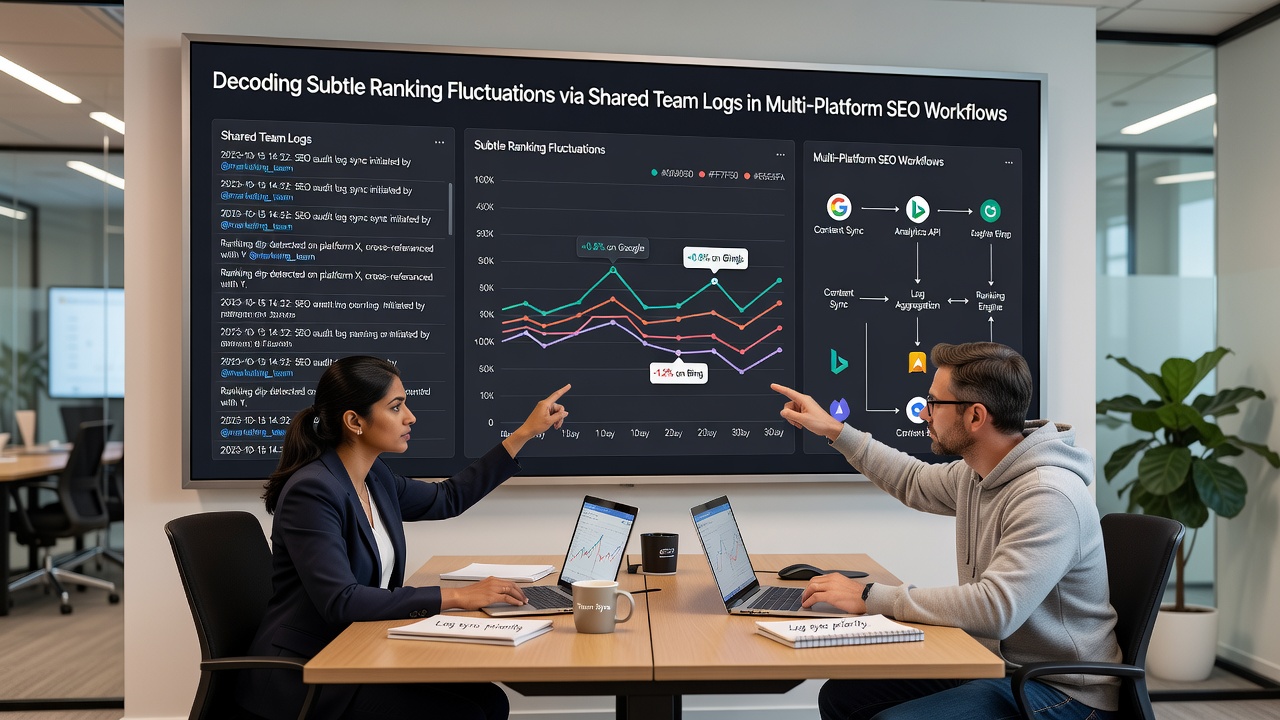
Search engine rankings shift in small increments that teams track through coordinated log systems spanning several platforms at once. These logs compile entries from analytics dashboards, search console exports, and third-party monitoring services so that distributed groups can spot patterns without duplicating effort. In October 2026 several enterprise workflows adopted unified timestamp formats that allowed entries from desktop crawlers and mobile indexing reports to align automatically.
Core Components of Shared Logging Systems
Teams record every ranking observation with fields that include keyword phrase, platform identifier, device type, and crawl timestamp. The resulting dataset supports queries that isolate fluctuations tied to specific updates such as title tag revisions or internal link adjustments. Data shows that consistent field formatting reduces the time required to correlate a two-position drop with a simultaneous change in click-through rate on one platform while another platform remains stable.
Multi-Platform Data Integration Practices
Integration begins when each platform exports its metrics into a common repository that applies standardized units for position, impressions, and clicks. Researchers discovered that mapping mobile-first indexing signals alongside desktop crawl budgets reveals discrepancies that single-platform views miss. One workflow integrated logs from a European Commission digital market report with internal records, which helped identify regional ranking patterns that emerged after a core update rolled out in stages.
Analytical Techniques Applied to Log Entries
Analysts apply time-series filters that group entries by week and by platform cluster. They then calculate standard deviation across position values to flag keywords whose movement exceeds the baseline established during the prior quarter. When a cluster of keywords shows coordinated movement, teams review the shared notes attached to each log line to determine whether the change followed a content deployment or a technical configuration shift. Figures reveal that teams using this approach reduced the average time to diagnose a ranking issue from fourteen days to six days across portfolios containing more than five hundred monitored terms.

Examples from Distributed Team Environments
One North American agency maintained separate log channels for its Canadian and Australian clients yet merged them nightly into a single view. When a subtle drop appeared on the Canadian side after an algorithm adjustment, the merged dataset showed that the same keywords on Australian domains experienced an earlier but smaller movement. Cross-referencing the timestamps with Innovation, Science and Economic Development Canada e-commerce statistics confirmed that seasonal traffic patterns had amplified the fluctuation on one region while masking it on the other. Teams then adjusted reporting thresholds accordingly.
Workflow Adjustments Following Log Analysis
After patterns surface, teams revise their content calendars and technical checklists to test the suspected causes. They add new log fields that capture the date of each test deployment so future queries can isolate effects more precisely. Observers note that the addition of these fields improves the signal-to-noise ratio in subsequent ranking reviews. The process repeats at regular intervals, with each cycle refining the granularity of the shared entries.
Conclusion
Shared team logs serve as the connective tissue that turns isolated platform observations into coherent narratives about ranking behavior. When teams maintain consistent formatting, align timestamps across regions, and attach contextual notes to every entry, subtle fluctuations become traceable events rather than unexplained noise. The practices outlined here continue to evolve as platforms introduce new reporting fields and as distributed groups refine their query techniques for larger datasets.